The Eloquence of Omission: How the Most Refined Men Dress by Subtraction
There is a particular kind of confidence that announces itself without announcement. It enters a room not through volume or spectacle, but through an almost unsettling precision—a sense that every element of a man's appearance has been considered, weighed, and, more often than not, removed. This is the quiet authority of restraint, and in American luxury menswear, it has never been more consequential.
For years, the prevailing instinct in men's fashion leaned toward accumulation. More texture, more pattern, more hardware, more proof. The well-dressed man was understood to be the thoroughly appointed one. Yet something has shifted—gradually at first, then with gathering conviction—among the men who take their wardrobes most seriously. The conversation has turned from addition to subtraction, and the results are, by any measure, more compelling.
The Discipline Behind the Simplicity
It would be a mistake to confuse restraint with minimalism in its purely aesthetic sense. The two are related but distinct. Minimalism, as a design doctrine, concerns itself with form—clean lines, neutral palettes, the absence of ornament. Restraint, as a philosophy of dress, concerns itself with intention. A man practicing restraint may wear a single bold color or a richly textured fabric; what he will not do is wear it carelessly, or pile it atop competing elements that dilute its effect.
The distinction matters because it illuminates why so many attempts at "simple" dressing fall flat. A plain navy suit worn without understanding is merely plain. That same suit, cut to exacting specification from a cloth that rewards close inspection—a fine Loro Piana wool, perhaps, or a Scabal flannel with just enough weight to drape with authority—becomes something else entirely. The simplicity, in that case, is the result of enormous effort. The absence of distraction is itself the achievement.
This is the paradox that designers working at the upper registers of menswear have come to understand deeply: the less you ask of a garment's surface, the more you demand of its substance. Strip away the flourishes, and every seam, every proportion, every choice of button becomes load-bearing. There is nowhere to hide.
What the American Market Is Learning
American men have historically maintained a complicated relationship with understatement. The country's sartorial culture has long celebrated a certain forthright quality in dress—the power suit as armor, the statement watch as credential, the logo as shorthand for success. These impulses are understandable. In a culture that prizes self-made achievement, there is a natural desire to make that achievement visible.
But the most sophisticated segment of the American market is undergoing a quiet recalibration. Across cities like New York, Chicago, and Los Angeles, a generation of professionals and creative leaders—men who have arrived, in whatever sense that word applies to them—are increasingly drawn to pieces that communicate through craft rather than branding. The logo recedes. The silhouette advances.
This shift reflects, in part, a broader cultural maturation. When luxury becomes widely accessible through diffusion lines and fast-fashion approximations, the truly rare thing is no longer the label itself—it is the knowledge required to evaluate what lies beneath it. The man who can identify a hand-felled lapel, or recognize the particular hand of a cloth woven on traditional shuttle looms in England's West of England mills, possesses something that cannot be purchased at scale. His restraint is, in its way, a form of fluency.
The Capsule as a Form of Editing
One practical expression of this philosophy is the rigorously curated wardrobe—what some have taken to calling the considered capsule. Not a capsule in the reductive, lifestyle-marketing sense of a prescribed list of items, but rather a personal vocabulary of pieces chosen for their singular authority and their capacity to work in concert without crowding one another.
The gentleman who dresses this way might own three suits rather than twelve—each one exceptional, each one fitted with the kind of precision that makes the question of what to wear largely irrelevant. His shirts are few but irreproachable. His shoes resolve the question of footwear for every occasion he is likely to encounter. His accessories, if he wears them at all, are chosen with the same economy: a watch of genuine mechanical interest, a pocket square of understated quality, perhaps a single ring of personal significance.
What this approach demands, above all, is the willingness to resist. To resist the novelty of the seasonal sale. To resist the momentary appeal of a trend that will not survive the year. To resist, most fundamentally, the anxiety that drives so much acquisition—the fear that what one already owns is somehow insufficient.
Craft as the Reward for Restraint
When a wardrobe is stripped to its essentials, the quality of what remains becomes the entire story. This is where the philosophy of restraint and the values of true luxury craftsmanship converge most naturally. A garment that must carry the full weight of a man's sartorial expression cannot afford to be merely adequate. It must be, in every sense that matters, extraordinary.
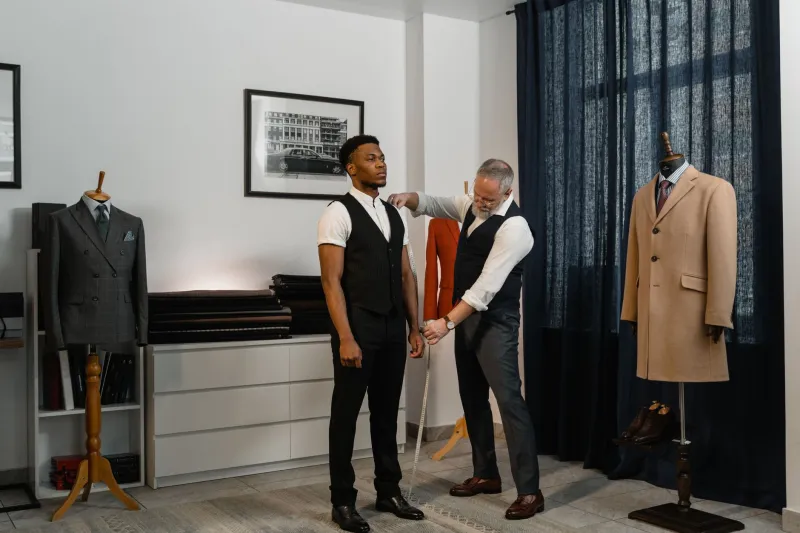
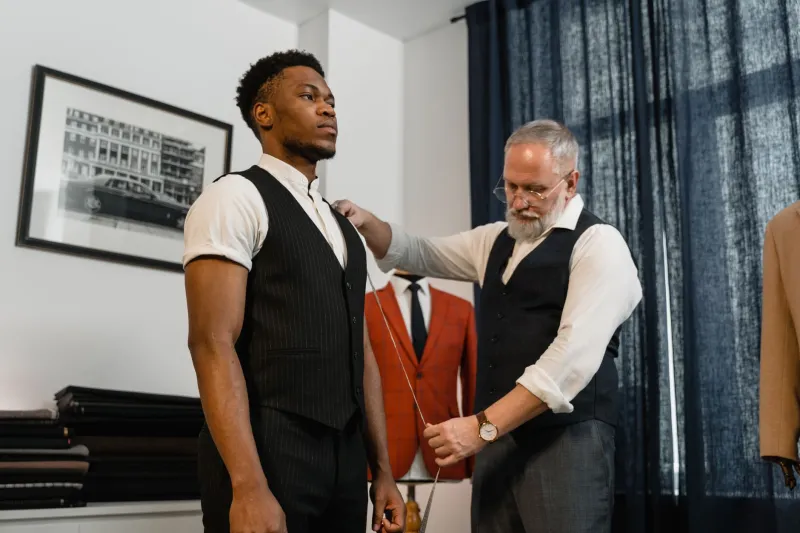
This is why the resurgence of interest in bespoke and made-to-measure tailoring is inseparable from the broader movement toward restraint. When a man commits to wearing less—to dressing with greater selectivity and purpose—he inevitably begins to invest more in the individual pieces he retains. The economics shift. What once might have been spread across a sprawling, uneven collection concentrates instead in a smaller number of garments of genuine distinction.
The tailors and makers who have always operated at this level understand this intuitively. Their clients are not men seeking variety. They are men seeking permanence—pieces that will improve with age, that will carry the evidence of a life lived with attention, that will, in time, become as individual as the men who wear them.
The Final Word on What to Leave Behind
Dressing with restraint is, at its core, an act of confidence. It requires a man to trust that his presence—his bearing, his manner, the quality of his attention—is sufficient without amplification. It asks him to believe that the right cloth, cut correctly and worn with conviction, communicates more than any accumulation of accessories or signals ever could.
In this sense, the philosophy is less about fashion than it is about character. The wardrobe becomes a reflection of a particular kind of self-knowledge: an understanding of what one actually needs, what genuinely serves, and what can, without loss, be left behind.
For the man who arrives at this understanding, the reward is considerable. He dresses faster, with less deliberation and more certainty. He spends more thoughtfully, and accumulates regret less readily. And he moves through the world with the particular ease of someone who has nothing to prove—because everything that needs to be said has already been said, quietly and precisely, by the clothes themselves.