Visible to Those Who Know: The New Language of Quiet Luxury in American Menswear
There is a particular kind of confidence that requires no introduction. It does not arrive draped in monograms or anchored by oversized hardware. It enters a room in a beautifully weighted wool overcoat, cut with precision at the shoulder, and says nothing at all — which is, of course, precisely the point.
Across the American menswear landscape, a meaningful and lasting shift is underway. The loudest voices in luxury are growing quieter, and the men who have always understood the difference between dressing well and dressing loudly are finding more options than ever to align their wardrobes with their values. The era of conspicuous consumption — of logos worn as social currency — is yielding to something more enduring: a philosophy of dress rooted in craft, material, and the kind of understatement that rewards close attention.
The Decline of the Emblem
For much of the past three decades, the luxury industry operated on a relatively straightforward premise: visibility equals value. A recognizable logo on a chest pocket or belt buckle served as shorthand for aspiration, communicating purchasing power to the widest possible audience. It was, in many ways, a democratization of luxury signaling — anyone willing to spend the price of admission could broadcast membership in a particular social tier.
But something has shifted among the most discerning segment of American consumers. The men who have accumulated genuine cultural and financial capital are increasingly disinterested in broadcasting it through brand emblems. For this cohort, the logo has become associated not with sophistication but with its performance — a distinction that matters enormously to those who have spent years developing a genuine eye for quality.
The market has responded. Brands that built their reputations on restrained aesthetics — those whose identity was always embedded in construction and cloth rather than insignia — are experiencing renewed and accelerated relevance. Meanwhile, several heritage houses have begun to quietly reposition their most elevated lines around subtlety, moving monogram-heavy pieces to more commercial diffusion ranges while reserving their finest craftsmanship for pieces that carry no identifying marks whatsoever.
When the Detail Is the Statement
If the logo has been retired as the primary vehicle of luxury communication, what has taken its place? The answer lies in the accumulation of details that reveal themselves only upon close inspection — the kind of observation that presupposes knowledge and attentiveness.
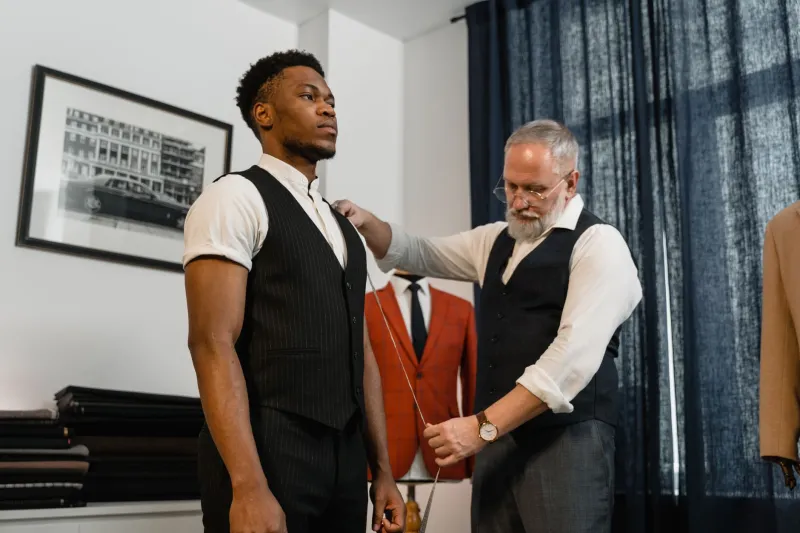
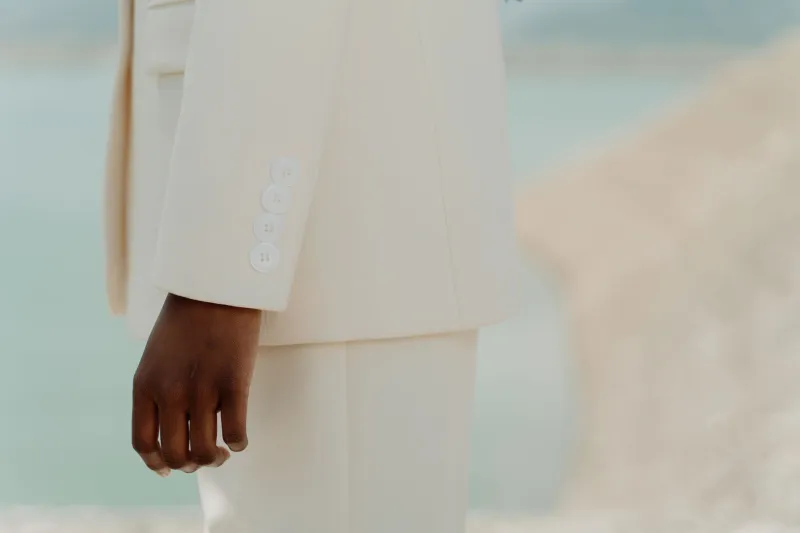
Consider the interior of a well-made sport coat: the hand-stitched pick stitching along the lapel, the surgeon's cuffs that actually unbutton, the full canvas construction that breathes and molds to the body over years of wear. None of these features are visible at a distance. None of them photograph particularly well for social media. Yet to a man who understands tailoring, they communicate more about the garment's provenance and the wearer's judgment than any woven label ever could.
The same logic applies across the full spectrum of refined menswear. In shirting, it is the count of the cotton, the mother-of-pearl buttons, the precise alignment of the pattern at every seam. In footwear, it is the Goodyear welt, the hand-burnished patina, the way a sole has been constructed to last decades rather than seasons. In knitwear, it is the weight and drape of a Scottish cashmere that speaks before a single word is exchanged.
These are details that cannot be faked at scale, and that is precisely their value. They represent a form of luxury that is genuinely exclusive — not because of an artificially restricted price point, but because appreciating them requires a level of education and attention that cannot be shortcut.
American Men and the Cultivation of Taste
It would be a mistake to assume that this sensibility is new to American men, though it has perhaps been less visible than its European counterpart. There has always existed, in cities like New York, Chicago, and San Francisco, a tradition of quiet dressing among men of genuine refinement — men who learned the difference between a Neapolitan shoulder and a Roman one, who traveled to London for their shirts and understood why the journey was worth making.
What is new is the broadening of this sensibility. The internet, for all its role in accelerating trend cycles and amplifying the performative dimensions of fashion, has also created communities of genuinely knowledgeable men who have taught themselves the vocabulary of craft. Forums dedicated to tailoring, heritage workwear, and fine accessories have cultivated a generation of American consumers who approach menswear with the same seriousness they might bring to wine or architecture.
For these men, the appeal of understated luxury is not affectation — it is the natural expression of a developed aesthetic. They are not rejecting logos because logos are unfashionable at this particular moment. They are rejecting them because they have moved beyond the need for external validation of their taste.
The Brands Defining the Shift
The brands benefiting most from this realignment share certain characteristics. They tend to be deeply invested in their supply chains, working with mills and artisans whose names they are proud to share. They prioritize longevity over novelty, designing pieces meant to outlast the season in which they are purchased. And they communicate their identity not through aggressive branding but through the quality of the object itself — trusting that the right customer will recognize what they are holding.
This approach demands a different kind of relationship between brand and consumer. It requires education, patience, and a willingness to let the work speak without amplification. In an era of algorithmic marketing and instant gratification, it is, in its own way, a radical stance.
It is also, ultimately, the most honest form of luxury. A garment that earns its price through the integrity of its construction and the quality of its materials makes a claim that can be verified by anyone willing to look closely enough. It does not need a logo because it does not need to borrow credibility from a name. It carries its own.
Dressing for the Discerning Eye
There is a phrase that circulates quietly among men who take dress seriously: dressed for those who know. It captures, in four words, the entire philosophy under discussion. The goal is not invisibility — a beautifully tailored suit is never invisible — but rather a form of communication that operates on a frequency unavailable to those who haven't done the work of developing their eye.
For the American man who aspires to this standard, the path forward is one of patient accumulation rather than conspicuous acquisition. It involves learning to recognize quality before learning to display it, building a wardrobe of pieces that will reward daily interaction for years, and gradually developing the confidence to let the clothes themselves carry the conversation.
True elegance has always been self-sufficient. It does not require a logo to announce its presence. It simply arrives — and those who understand, understand immediately.