Sewn in America: How a New Generation of Tailors Is Rewriting the Rules of Luxury Menswear
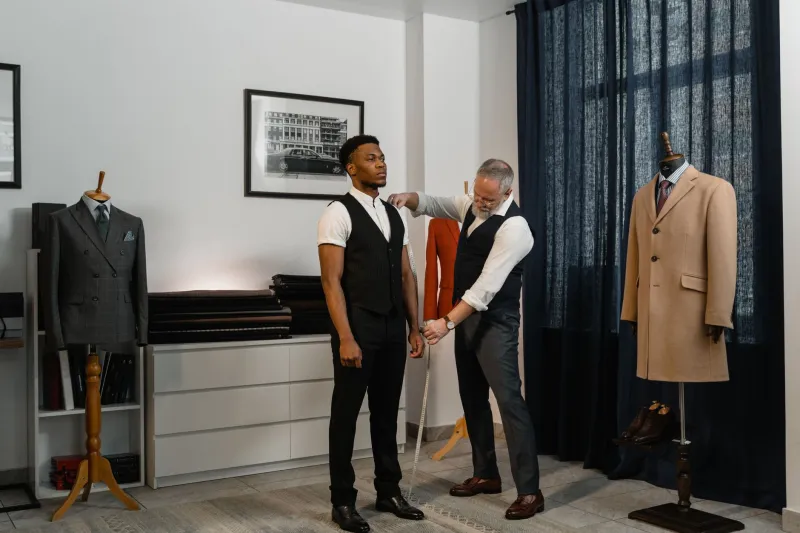
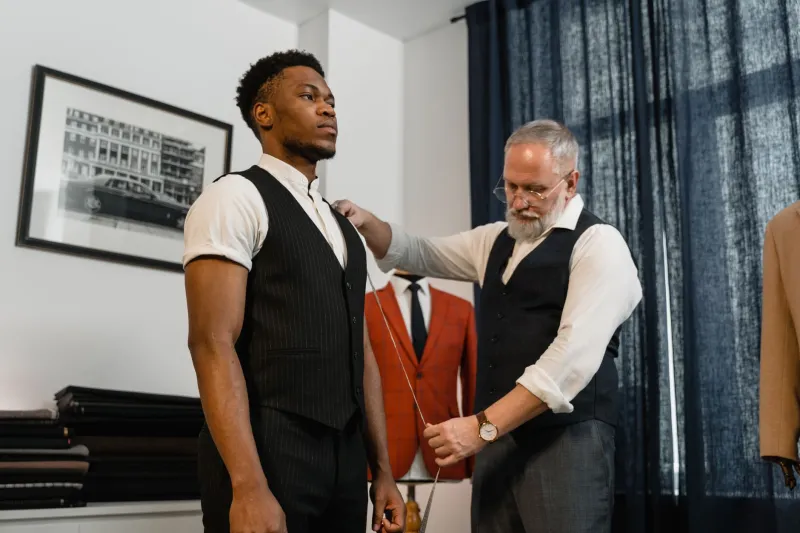
There is a particular kind of confidence that arrives not from the label inside a jacket, but from the way that jacket was made — measured to your precise posture, cut to accommodate the slight asymmetry of your shoulders, finished in a cloth selected during a private consultation that lasted the better part of an afternoon. It is confidence earned through process, through patience, and through the singular attention of a craftsman who knows your name.
For much of the past two decades, that experience felt like an artifact of another era — the province of Savile Row pilgrims or the quietly wealthy who maintained longstanding accounts with European houses. But something has shifted. Across American cities, from the tailoring districts of Chicago to the sunlit ateliers of Los Angeles, a new generation of makers is establishing something that feels less like a trend and more like a correction.
The American custom tailor is having his moment.
The Dissatisfaction That Sparked a Movement
To understand why this renaissance is happening now, one must first reckon with what preceded it. The past decade delivered an unprecedented volume of menswear — fast, cheap, algorithmically optimized — and with it, a growing sense of aesthetic fatigue among discerning American men. The suit that fits adequately, the shirt that photographs well but hangs indifferently, the jacket purchased in haste and donated without ceremony: these became familiar frustrations.
Simultaneously, a broader cultural conversation about provenance and intentionality began reshaping consumer values. Men who had grown accustomed to asking where their food was sourced or who had made their furniture began asking the same of their clothing. The answers from mass-market producers were rarely satisfying.
Into that gap stepped a cohort of American tailors — many of them trained under European masters, others self-taught through obsessive study and apprenticeship — who recognized that the appetite for genuine craft had not disappeared. It had simply been waiting for someone to feed it properly.
What "Custom" Means Beyond the Fitting Room
It would be a mistake to reduce this movement to mere bespoke construction — to treat it as though the sole distinction between a custom garment and a retail one is the number of fittings involved. The tailors driving this renaissance understand that elevated customization is fundamentally relational.
When a client walks into a contemporary American atelier, the conversation rarely begins with cloth swatches. It begins with questions. How does the client spend his days? Does he stand at a lectern or behind a desk? Does he travel frequently, and if so, to what climates? What does he wish to communicate in a room before he speaks? These inquiries are not affectations — they are the foundation upon which a genuinely useful garment is built.
This philosophy of purposeful making distinguishes the best American tailors from both their mass-market counterparts and, in certain respects, from the more ceremonial traditions of old-world tailoring. There is an inherent pragmatism to the American approach — a directness that acknowledges the client's life as it is actually lived, not as tradition imagines it ought to be.
The Cities Leading the Charge
Chicago has long maintained a quiet tailoring culture, rooted in the city's history as a garment manufacturing center, and several ateliers there continue to produce work of remarkable technical distinction. New York, predictably, offers the broadest concentration of talent — from the Garment District's remaining craftsmen to newer studios in Brooklyn catering to a younger, design-literate clientele.
Less expected, perhaps, is the vitality emerging from cities like Nashville, Denver, and Houston, where a generation of clients with disposable income and increasingly sophisticated taste is discovering that proximity to one's tailor is itself a luxury. The ability to walk into a studio, to handle the cloth, to build a relationship over multiple commissions — these are pleasures that no e-commerce platform can approximate.
In Los Angeles, the intersection of entertainment, technology, and a climate that demands year-round versatility has produced a distinctive strand of American tailoring: lighter in construction, more experimental in silhouette, yet no less rigorous in its standards of execution. The city's tailors have learned to make garments that move through multiple registers of formality without apology.
The Value of the Local Relationship
Perhaps the most underappreciated dimension of this movement is what it offers beyond the garment itself: continuity. A client who establishes a relationship with an American tailor is investing not merely in a suit or a sport coat, but in an ongoing dialogue about his evolving aesthetic, his changing circumstances, his wardrobe as a whole.
This is a fundamentally different proposition from purchasing a garment — even a very fine one — from a brand whose designers will never know his name. The American tailor who has dressed a client through a decade of professional milestones, who has adjusted a jacket to account for changed posture or shifting weight, who has counseled against a cloth that would not serve its intended purpose: that tailor occupies a role that is genuinely irreplaceable.
There is also an economic argument worth making plainly. A custom garment from an American atelier, priced honestly to reflect the labor and materials involved, may appear costly at the point of purchase. Measured against the cumulative expenditure of replacing inferior ready-to-wear every few seasons, however, the calculus shifts considerably. Quality, properly executed, is almost always the more efficient investment.
What Comes Next
The tailors themselves are measured in their optimism — craftsmen tend not to be given to hyperbole — but there is a genuine sense that the conditions for sustained growth are present. A generation of American men is arriving at the conclusion that their wardrobes deserve the same deliberate attention they apply to other significant decisions in their lives. They are seeking makers who can translate that intention into cloth and thread.
For those who have not yet made the acquaintance of a tailor whose work they trust, the counsel is straightforward: begin. Visit a studio. Handle the cloth. Ask the questions that matter to you, and observe whether the answers reflect genuine knowledge or polished salesmanship. The distinction will be evident almost immediately.
The American tailor does not ask for your loyalty on the basis of heritage or prestige alone. He earns it, fitting by fitting, commission by commission, through the quiet accumulation of work that is made for you and no one else.
In a wardrobe crowded with the anonymous and the adequate, that is no small thing.