The Education No Algorithm Can Provide: Learning Sartorial Mastery Through Observation

Photo by Photo by Vitaly Gariev on Unsplash on Unsplash
Every man who dresses exceptionally well learned it from somewhere. Not from a magazine, not from a recommendation engine, and not from a single transformative purchase—but from years of watching other men and gradually, quietly, absorbing the principles that governed their choices.
This is the oldest form of sartorial education, and it remains the most reliable. Call it an invisible apprenticeship: an unstructured, largely unacknowledged process of learning that happens in boardrooms and at dinner tables, on sidewalks and in hotel lobbies, wherever men who dress with genuine conviction happen to be present and observable.
The challenge, for the man who wishes to pursue this education deliberately, is knowing what to look for.
Why Algorithms Cannot Teach Taste
Digital platforms have made it easier than ever to encounter images of well-dressed men. They have not made it easier to develop taste. The distinction matters enormously.
Algorithms optimize for engagement, which in visual media means they optimize for the dramatic, the novel, and the immediately legible. The kind of dressing that genuinely rewards study—the kind that reveals more the longer you look—does not perform well in this environment. A perfectly proportioned suit in a mid-grey flannel, worn with a white shirt and a silk tie in a muted pattern, will never accumulate the same attention as something louder and more immediately arresting. Yet the former contains far more to learn from.
The men worth studying, in other words, are frequently invisible to the platforms that claim to curate style. They are found in person, in the environments where elegant men actually live and work.
Finding Your Subjects
The first step in this education is identifying the right men to observe. This is more nuanced than it might appear. The goal is not to find men who are fashionable—fashionable men are often the least instructive, because their choices are reactive rather than principled. The goal is to find men whose clothing appears to have been arrived at through long deliberation, whose wardrobes seem settled and coherent rather than assembled in response to external pressure.
In most American cities, these men are present in certain predictable contexts: established law firms, private banking, the boards of cultural institutions, the older membership of certain clubs. They are often, though not exclusively, older—men who have had decades to refine their approach and discard what does not serve them.
They are also, frequently, the men who make the least effort to be noticed. This is itself instructive.
The Details That Repay Attention
Once you have identified a subject worth studying, the education begins in specifics. Broad impressions are not enough. The following details deserve particular attention:
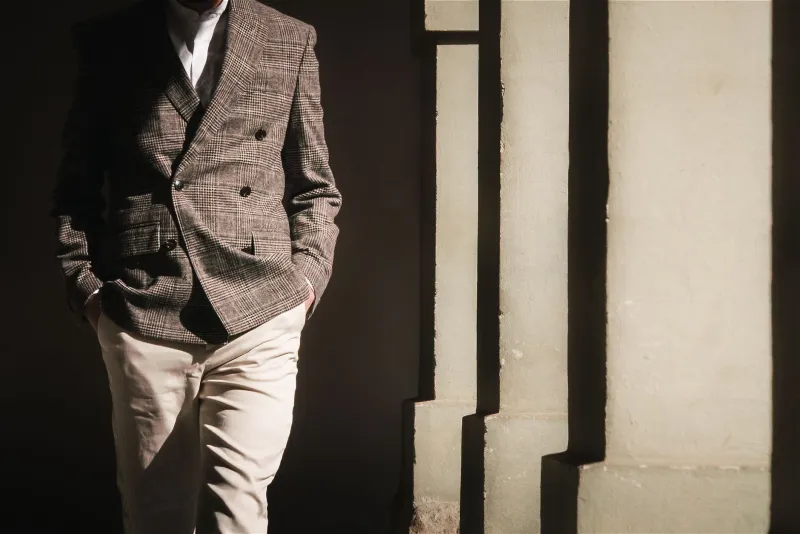
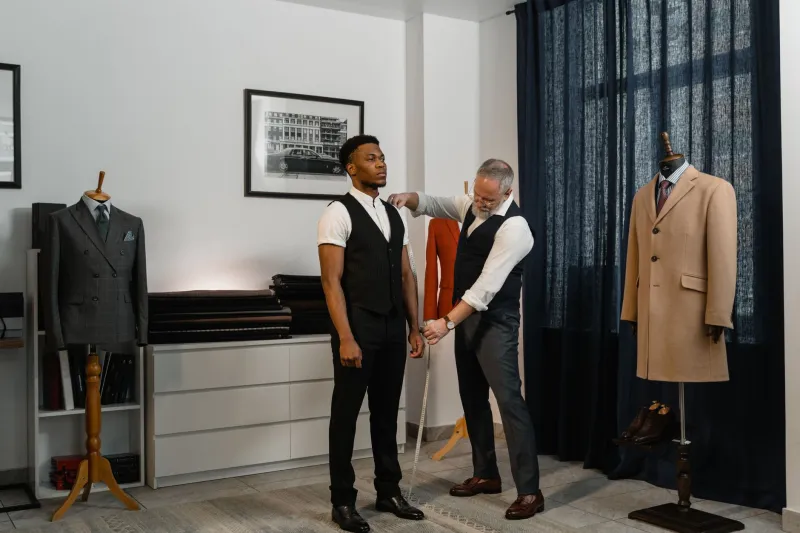
Fit across the shoulders. The shoulder seam is the most consequential measurement in tailoring, and it is also the most difficult to correct after the fact. A jacket whose shoulder seam sits precisely at the shoulder's edge—not rolling forward, not extending beyond—signals either exceptional off-the-rack luck or, more likely, careful tailoring. Note where the seam falls and what it does to the overall silhouette.
The trouser break. How much fabric pools at the shoe—or doesn't—tells you a great deal about a man's relationship with proportion. A slight break, or none at all, typically signals deliberateness. An excess of fabric at the ankle is usually the result of inattention. Note which choice the man has made and how it affects the visual line of his body.
The collar gap. When a man's jacket collar stands away from his shirt collar, it indicates either that the jacket is too large in the chest or that it was not built for his particular posture. A collar that lies flat and smooth against the shirt beneath it is a sign of either precise bespoke work or a very fortunate fit.
Fabric behavior in motion. This is one of the most underappreciated things to observe. Quality cloth moves differently than its inferior counterparts. It drapes rather than bunches. It recovers its shape after compression. Watch how a man's jacket behaves when he sits and stands, when he reaches for something, when he turns. The fabric will tell you things the label will not.
What he does not wear. Restraint is as legible as presence. The man who wears no pocket square, no lapel pin, no visible logo—and whose ensemble nevertheless reads as complete—has achieved something that requires genuine understanding. Study the absence as carefully as the presence.
The Art of Principled Adaptation
Observation without translation is merely imitation, and imitation without understanding produces results that are, at best, approximate. The goal of this apprenticeship is not to replicate what you see but to extract the underlying principles and apply them to your own circumstances.
If you observe that a man you admire consistently wears his shirts with a modest collar spread and a tie that sits with a clean, dimpled knot, the lesson is not that you should purchase his specific shirt and tie. The lesson is about the visual relationship between collar and knot, about the proportion of the triangle of shirt visible above the jacket's lapels, about the discipline of not allowing the tie to overwhelm the face. That principle can be applied to any shirt, any tie, any collar shape.
This is the work that separates genuine learning from shopping.
Building a Personal Reference Library
Over time, the observant man accumulates what might be called a mental reference library—a catalog of images, principles, and specific details drawn from years of careful attention. This library is more valuable than any editorial archive because it is curated by firsthand experience rather than commercial interest.
Some men keep physical notes. Others simply allow the observations to sediment into instinct—a process that takes longer but produces a more integrated result. Either approach works. What matters is the habit of deliberate attention, maintained consistently across years.
The Patience Required
This is not a rapid education. The man who expects to develop genuine taste in a season or two will be disappointed. Real sartorial intelligence accumulates slowly, through repeated exposure and gradual refinement. The apprenticeship is invisible precisely because it has no formal structure, no graduation date, no certificate of completion.
What it produces, eventually, is something that cannot be purchased or downloaded: a settled, principled relationship with clothing that is entirely one's own—informed by admiration for others but not beholden to any of them. That independence is the final lesson, and perhaps the most important one.