The Architecture of the Self: Why Proportion Matters More Than Prestige
There is a scene that plays out with remarkable regularity in the lobbies of fine hotels, the dining rooms of established restaurants, and the corridors of serious American institutions: two men, both well-dressed by any conventional measure, both wearing clothing that cost serious money. And yet one of them looks right — composed, authoritative, at ease in his own presentation — and the other simply does not. The clothes are there. The effort is evident. Something is nonetheless missing.
That something, almost invariably, is fit.
Not fit in the narrow tailoring sense of hemmed trousers and taken-in side seams, but fit in the deeper, more architectural sense: the alignment of a garment's proportions with the specific geometry of the body wearing it. The relationship between shoulder width and chest breadth. The balance between trouser rise and torso length. The way a collar's spread either flatters or competes with the width of a jaw. These are not details. They are the substance of the thing.
The Tyranny of the Trend
American menswear, for all its recent sophistication, remains deeply susceptible to the cycle of silhouette trends — the pendulum that swings, decade by decade, between the slim and the generous, the cropped and the elongated, the structured and the relaxed. Each swing is accompanied by a chorus of editorial voices declaring the previous aesthetic obsolete and the new one essential. And each swing leaves in its wake a generation of men who dressed for the moment rather than for themselves, and who look, in photographs taken just a few years later, faintly costumed.
The man who has developed a genuine understanding of his own proportions is largely immune to this cycle. He does not reject new silhouettes out of stubbornness or conservatism — he evaluates them against a clear and internalized standard: does this serve my specific architecture? If a broader lapel flatters the width of his chest, he adopts it. If a higher-rise trouser suits the length of his torso, he wears it. If neither is currently fashionable, he wears them anyway, and he is right to do so.
This is not contrarianism. It is the application of a consistent and personal logic to an industry that profits, structurally, from inconstancy.
Knowing Your Numbers — and More
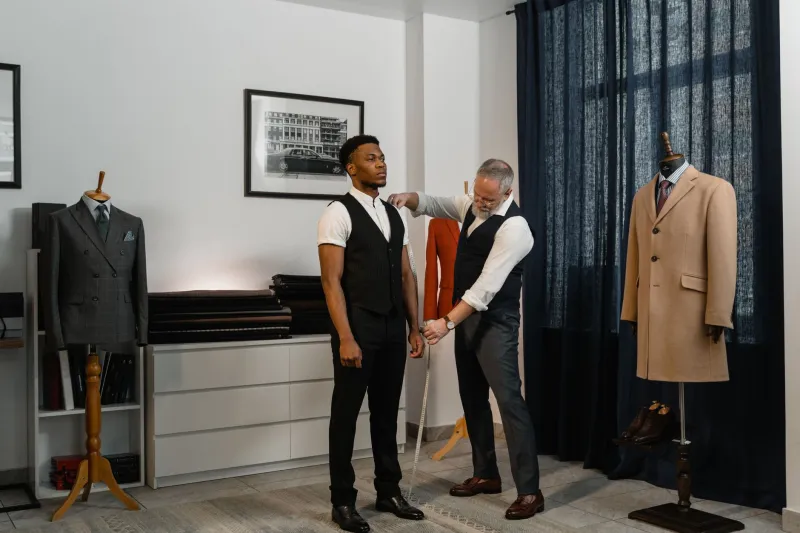
The first step toward proportion-conscious dressing is the acquisition of precise measurements. Not the approximate measurements that most men carry in their heads — "I'm a 40 regular, 32 waist" — but the granular, comprehensive set of numbers that a skilled tailor records: chest, waist, hip, seat, shoulder width, sleeve length from shoulder and from neck, back length, trouser inseam and outseam, thigh circumference, knee width, and the critical relationship between these numbers.
But measurements alone are insufficient. Numbers describe the body; they do not interpret it. A man with a 40-inch chest and a 38-inch waist occupies the same numerical territory as a man with a 40-inch chest and a 38-inch waist but with two inches more back length and notably sloped shoulders — and these two men will look entirely different in the same garment. The numbers are the beginning of self-knowledge, not the end of it.
The deeper work involves understanding the visual logic of one's own frame. What proportion of height is torso versus leg? Where does the body carry its weight — chest, shoulder, hip? Is the neck long or short, and how does this affect collar choices? Are the shoulders square or sloped, and how does this influence the construction of a jacket's shoulder seam? These are the questions that a skilled tailor or clothier can help a man answer — and once answered, they become the permanent operating system through which every future acquisition is evaluated.
The Discipline of Rejection
Perhaps the most demanding aspect of proportion-conscious dressing is the willingness to reject garments that fail the fit standard, regardless of their other merits. This requires a discipline that runs directly counter to the seductions of label, novelty, and price.
A jacket from a house of considerable prestige, worn by men whose names appear regularly in the pages of serious style publications, may nonetheless be cut for a body type that does not resemble yours. The shoulders may be too wide. The chest may be too full. The lapels may be proportioned for a taller man. None of this is a failure of the garment — it is simply a mismatch. And a mismatch at this level of expenditure is not a bargain; it is an expensive mistake.
The man who has internalized his own proportions can identify this mismatch within moments of trying a garment on. He does not need to be told. He feels it — in the pull of the fabric across the back, in the gap between collar and neck, in the way the hem breaks at the wrong point on the thigh. His body is the instrument of evaluation, and it is, with practice, a remarkably precise one.
This same discipline applies to alterations. A skilled tailor can accomplish a great deal — suppressing a waist, shortening a sleeve, narrowing a trouser leg — but there are structural limits to what alteration can achieve. A jacket with a shoulder seam that sits half an inch off the natural shoulder cannot be corrected by any amount of subsequent work. A trouser with a rise that is fundamentally incompatible with a man's torso-to-leg ratio will never sit correctly regardless of how it is hemmed. Knowing these limits — understanding what can be fixed and what cannot — is essential to making sound acquisitions in the first place.
The Luxury That Cannot Be Purchased
There is a particular irony embedded in the relationship between fit and luxury: the most expensive garments in the world will not make a man look well-dressed if they do not fit him correctly, while a modest garment cut with precision to his specific frame will make him look considerably better than his expenditure would suggest.
This is not an argument against investment in quality — far from it. It is an argument for sequencing that investment correctly. Before a man spends serious money on fabric, on construction, on provenance, he should spend whatever time and attention is required to understand his own body with exactitude. He should develop relationships with tailors and clothiers who share his commitment to proportion. He should establish the habit of trying before buying — not once, but as a non-negotiable condition of every acquisition.
The most elegantly dressed men in America — in business, in public life, in the quieter arenas of private accomplishment — are not, as a rule, wearing the most expensive clothing. They are wearing clothing that fits them. This is a distinction that sounds simple and proves, in practice, to be the work of years.
But it is work that pays. A man who knows his own proportions, who has the discipline to dress for his body rather than for the moment, who can walk past a beautifully made garment because it does not serve his specific architecture — that man carries himself with an authority that no label can confer and no trend can revoke. He has learned the one thing that cannot be bought off a rack: himself.