Dressed for the Next Generation: On Building a Wardrobe That Endures
In the back of a closet in a brownstone in Brooklyn, there hangs a single-breasted overcoat in midnight navy wool. It belonged to a grandfather who wore it to board meetings in the 1960s, then to his son who carried it through the winters of his own professional ascent, and now to a thirty-four-year-old architect who wears it on the days he wants to feel, as he puts it, "like someone who has already figured things out." The coat has been relined twice. The buttons were replaced once. It fits him the way it fit his grandfather — which is to say, imperfectly, and perfectly.
This coat was not purchased as an heirloom. It was purchased as a coat. But it was purchased well — from a tailor who understood that the proper function of a garment extends far beyond any single season, any single decade, any single life. And so it endures.
The Question of Time Horizon
Most men, when they shop for clothing, operate within an implicit time horizon of two to five years. They are buying for the version of themselves that exists now, in the context that exists now, against a backdrop of trends that exist now. This is a reasonable and practical approach. It is also, from a certain perspective, a profound waste.
The alternative — what might be called inheritance-oriented dressing — requires a fundamental reorientation of the question being asked. Instead of "Will I wear this often enough to justify the price?" the question becomes: "Is this piece so well made, so genuinely timeless in its design, and so durable in its construction that it could plausibly be worn by someone I love, twenty or forty years from now?"
This is not a romantic abstraction. It is a rigorous evaluative framework, and it changes everything about how one shops.
What Survives
Not all garments are candidates for generational longevity, and it is worth being precise about which ones are. The pieces most likely to carry forward across decades share several characteristics.
First, they are made from natural fibers of exceptional quality. Wool, cashmere, linen, cotton, and leather — when sourced and processed with genuine care — do not merely resist aging; they improve with it. A heavyweight Harris Tweed jacket develops a patina of wear that synthetics cannot replicate. A full-grain leather belt softens and molds in ways that bonded leather never will. The fiber itself must be capable of a long life before the garment can aspire to one.
Second, they are cut in silhouettes that belong to no particular moment. The single-breasted suit in a moderate two-button configuration. The polo coat in camel. The plain-toe Oxford in dark brown calf. The crewneck sweater in a neutral tone. These are not "classic" pieces in the dismissive sense — they are not safe or unimaginative. They are forms that have proven, over the course of more than a century of menswear evolution, to be structurally sound: proportions that flatter the male body across a wide range of body types and ages, details that read as deliberate rather than dated.
Third — and this is perhaps the least discussed but most important quality — they are made with the kind of construction that can be repaired, altered, and restored. A suit with a full canvas chest piece can be relined, re-canvassed, and adjusted at the waist decades after it was made. A shoe with a welted construction can be resoled many times over. A garment that cannot be repaired is, by definition, a garment with a fixed and finite life.
The Psychology of Dressing Forward
There is something genuinely transformative about approaching a wardrobe with generational intent. It introduces a quality of deliberateness — of seriousness, even — that changes the entire experience of acquisition. Impulse purchases become essentially impossible. The question "Is this worth passing on?" is a remarkably effective filter against the seductions of novelty.
It also, interestingly, creates a different relationship with the garments one already owns. A man who is building for inheritance tends to care for his clothing differently — not obsessively, but attentively. He sends his suits to be properly pressed rather than throwing them in a bag. He uses cedar trees in his shoes. He stores his cashmere folded rather than hung. He understands that the longevity he is attempting to engineer depends not only on what he buys, but on how he maintains what he has.
Several men I have spoken with who have inherited significant pieces — a grandfather's Barbour wax jacket, a father's Rolex Datejust, an uncle's bespoke dinner suit from a London tailor — describe the experience of wearing those pieces in terms that go well beyond mere aesthetics. There is a quality of connection, of continuity, of being linked to a lineage of considered living, that no new garment can replicate. The piece carries meaning that was not manufactured into it. It was lived into it.
Evaluating for the Long Run
For the man who wishes to begin building with inheritance in mind, a few practical principles are worth establishing.
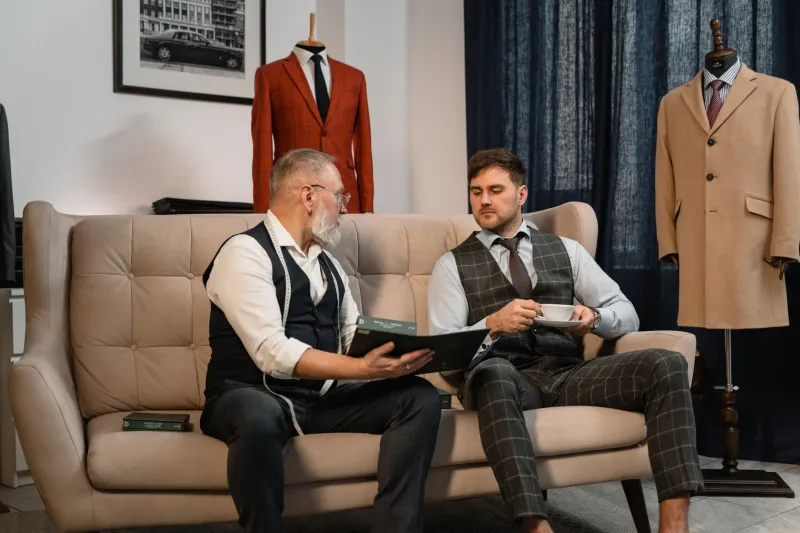
Seek out makers who speak openly about repairability. A shoemaker who offers resoling services, a tailor who keeps your measurements on file, a bag maker who offers a lifetime repair program — these are signals that the maker shares your time horizon. They are building for the long run because they believe in what they make.
Be skeptical of construction shortcuts that are invisible at point of sale but consequential over time. Fused interlinings rather than canvassed chests. Glued rather than welted soles. Machine-stitched rather than hand-finished buttonholes. These economies are not inherently disqualifying, but they are worth understanding — and they are worth asking about directly.
Finally, resist the temptation to confuse price with longevity. Not everything expensive is built to last, and not everything built to last is expensive. Some of the most enduring garments in American menswear tradition — the Levi's 501, the L.L. Bean Blucher moccasin, the Pendleton wool shirt — are not luxury goods in any conventional sense. They are, however, made with an integrity of materials and construction that has allowed them to persist across generations. The question is never what something costs. The question is what it is made of, and how.
A Different Kind of Investment
The financial case for inheritance-oriented dressing is straightforward: a $1,200 overcoat that lasts forty years and passes to a son who wears it for another thirty is an extraordinary value by any rational measure. But the more compelling argument is not financial. It is human.
To dress with the next generation in mind is to make a statement about time — about what endures and why, about the kind of man one intends to be and the kind of legacy one intends to leave. It is to understand that a wardrobe, at its most considered, is not merely a collection of garments. It is a set of objects that carry forward, in their fibers and their form, something of the life of the man who chose them.
The coat in that Brooklyn brownstone is not just a coat. It is evidence of a grandfather who understood, perhaps without ever articulating it, that the things we love most are the things we make to last.