The Gentleman's Essentials: Five Luxury Accessories That Define Enduring Style in 2025
Trends arrive and dissolve with relentless regularity, but certain accessories occupy a category entirely their own — objects of such intrinsic quality and cultural weight that they remain relevant long after seasonal collections have been forgotten. A well-chosen accessory does not merely complement an outfit; it communicates something essential about the man wearing it. These are the five pieces every sophisticated gentleman should consider foundational to his wardrobe in 2025.
1. The Mechanical Timepiece
Why It Matters
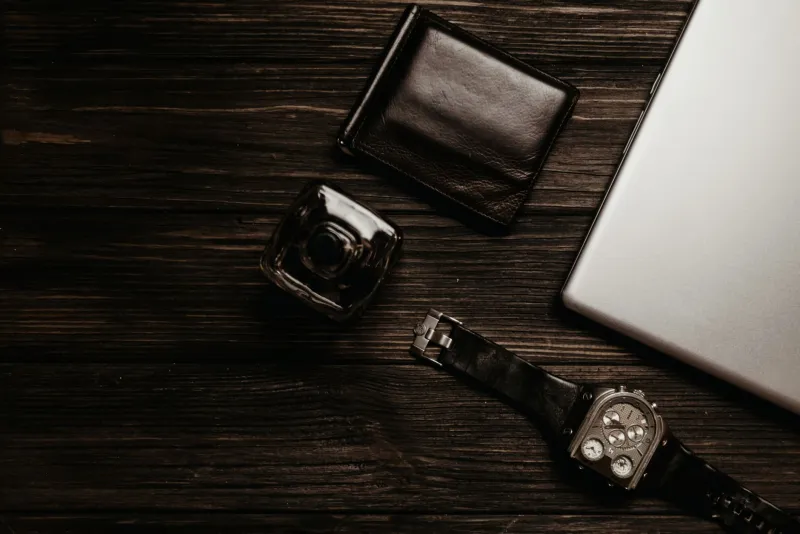
In an age when every pocket holds a device capable of displaying the precise time to the millisecond, the mechanical wristwatch has shed its utilitarian function entirely — and become something far more interesting. A fine mechanical watch is a philosophical object, a demonstration that precision can be achieved through ingenuity and craft rather than electricity. It is also, when chosen well, one of the most effective signals of understated discernment available to a man.
For 2025, the conversation has shifted decisively away from oversized sports references and toward refined dress watches with clean dials and restrained proportions. Pieces from Swiss houses with century-long histories carry an authority that newer brands, however technically impressive, have not yet earned. Look for cases measuring between 38 and 40 millimeters, applied indices rather than printed numerals, and movements that can be serviced — and therefore preserved — for generations.
Styling Consideration: A slim dress watch disappears beneath a French-cuffed shirt sleeve and reveals itself only when the jacket rises — a subtle disclosure that rewards the attentive observer.
2. The Full-Grain Leather Portfolio or Briefcase
Why It Matters
The bag a man carries to a meeting communicates before he has spoken a word. A distressed nylon backpack and a hand-stitched leather portfolio send entirely different messages about the man's relationship to quality and professionalism. For the modern American executive or creative professional, a full-grain leather portfolio or structured briefcase remains one of the highest-leverage investments in personal presentation.
Full-grain leather — the uppermost layer of the hide, retaining its natural surface — is the only grade worth considering at the luxury level. It develops a patina over years of use, growing more characterful rather than more worn. Avoid corrected-grain or bonded leather, which are engineered to look uniform and age poorly. Construction details matter enormously: look for saddle-stitched seams (which will not unravel if a single thread breaks), solid brass hardware, and clean interior organization that reflects genuine consideration for how professional men actually work.
Styling Consideration: A tan or cognac leather case introduces warmth against a navy or charcoal suit; a dark chocolate or black piece reads as formal authority. Either is appropriate; the choice should be deliberate.
3. The Silk Pocket Square
Why It Matters
No accessory offers a greater return on investment — in both cost and visual impact — than the silk pocket square. A single, well-chosen square can transform a straightforward navy blazer into something that feels considered and personal. It is the detail that separates a man who dresses from a man who has dressed.
The finest pocket squares are printed or woven in silk twill or satin-finish silk, hand-rolled at the edges rather than machine-hemmed. The hand-rolled edge, identifiable by its slight irregularity and softness, is the hallmark of quality in this category. Pattern and color selection should reflect personality without overwhelming the broader ensemble: a rich burgundy or forest green adds depth; a geometric or paisley print introduces quiet complexity; a white linen square (a related but distinct category) communicates classical restraint.
Styling Consideration: The puff fold and the flat presidential fold remain the two most versatile presentations. Avoid the overly engineered "peak" folds that read as effortful — elegance should appear uncontrived.
4. The Cashmere Scarf
Why It Matters
For the American gentleman navigating the colder months in cities from Boston to Seattle, a fine cashmere scarf is both practical and deeply elegant. Cashmere — the fine undercoat of the Cashmere goat, sourced primarily from Mongolia and Kashmir — offers warmth disproportionate to its weight, draping with a softness that no synthetic fiber can approximate.
Grade matters significantly in this category. Two-ply cashmere scarves from established Scottish or Italian mills represent the standard of excellence: dense enough to provide genuine insulation, fine enough to fold without bulk. A solid color — camel, ivory, charcoal, or navy — will integrate with virtually any coat or jacket, while a subtle herringbone or houndstooth weave adds texture without sacrificing versatility. Length should be generous, allowing for a proper Parisian drape or a tucked wrap without appearing stingy.
Styling Consideration: Draped loosely over an overcoat's lapels, a cashmere scarf achieves an effortless Continental quality. Tucked into a peacoat reads as more urban and contemporary. Both interpretations are correct; context dictates the choice.
5. The Handcrafted Leather Belt
Why It Matters
The belt is the most overlooked luxury accessory in the American man's wardrobe — and the one most likely to betray an otherwise impeccable ensemble. A low-quality belt, regardless of the quality of the suit or shoes surrounding it, introduces a note of incongruity that the trained eye cannot ignore.
A handcrafted belt in full-grain leather, with a solid brass or sterling buckle, is the corrective. Width should correspond to the trouser: 1.25 to 1.5 inches for dress trousers, slightly wider for casual wear. The leather should match or closely echo the shoes — a principle that sounds elementary but is routinely ignored. Edge finishing — whether burnished, painted, or raw — should be consistent and clean. A belt of this quality, resoled when necessary and cared for with a quality conditioner, will outlast a dozen of its inferior counterparts.
Styling Consideration: For formal business dress, the belt and shoe should share not only color but finish — matte with matte, polished with polished. This coherence, invisible when achieved and glaring when absent, is the essence of true elegance.
A Final Word on Acquisition
The accessories described above share a common characteristic: they improve, in both quality and personal meaning, with time. They are not acquisitions in the conventional sense — they are commitments. A man who builds his accessory wardrobe around these five categories will find that his style evolves not through replacement, but through deepening. That, at Alfred LeRoy, is precisely the kind of elegance we celebrate.