Cloth, Craft, and Character: The Case for Bespoke Tailoring in the Modern Wardrobe
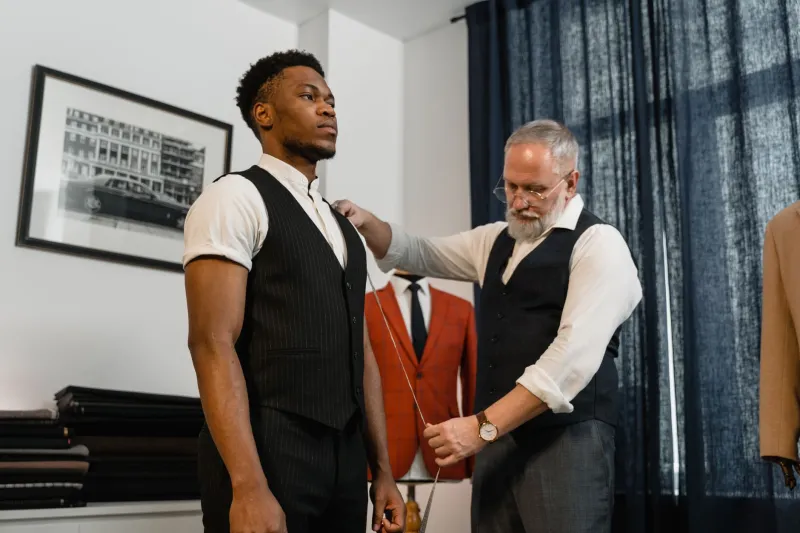
In an era of algorithm-driven fashion and disposable wardrobes, bespoke tailoring stands apart as something altogether more enduring. A suit made to your precise measurements is not merely clothing — it is a declaration of self-knowledge. For the discerning American gentleman, understanding the true value of custom tailoring may be the single most transformative step in refining personal style.
What "Bespoke" Actually Means
The word is used liberally in contemporary marketing, often stripped of its original meaning. True bespoke tailoring — derived from the English phrase "it has been bespoken," meaning the cloth has been spoken for — refers to a garment constructed entirely from scratch, pattern and all, for a single individual. There are no pre-cut shells, no standard block altered at the seams. Every element, from the canvas that gives a jacket its structure to the hand-stitched buttonholes that finish its cuffs, is created specifically for one body and one body alone.
This stands in sharp contrast to made-to-measure, which adapts an existing pattern to accommodate certain measurements, and ready-to-wear, which offers standardized sizing across a broad population. Both have their place. But neither can replicate what bespoke achieves: a garment that moves with you, drapes without tension, and flatters the particular proportions that make you distinctly yourself.
The Hands Behind the Cloth
Speak with any master tailor and the conversation quickly moves away from fabric swatches and toward philosophy. A bespoke suit requires upward of fifty hours of skilled labor. The chest canvas — rather than the fused interlining used in most commercial garments — is hand-padded with hundreds of tiny stitches, allowing the jacket to conform gradually to the wearer's posture over time. Sleeves are set by hand. The collar is shaped to follow the natural curve of the neck. Pockets are reinforced with precision that, while invisible to the eye, is felt every time you reach inside.
Master tailors in cities like New York and Chicago often describe their first consultation with a client less as a fitting and more as a conversation. "We are not just measuring shoulders and chest," one New York-based tailor with over three decades of experience explained. "We are measuring how a man stands, how he carries himself, what he does during his day. A man who sits at a desk for eight hours needs a different cut than one who moves through boardrooms and city streets."
That attentiveness — to posture, to lifestyle, to aspiration — is precisely what no algorithm can replicate.
The Investment, Honestly Considered
The cost of a true bespoke suit in a major American city typically begins around $3,500 and rises considerably from there, depending on the tailor's reputation and the cloth selected. To the uninitiated, this figure can seem extraordinary. Measured against a $500 department store suit, it appears almost irrational.
But the calculus changes when viewed across time. A well-constructed bespoke garment, properly maintained, will serve its owner for twenty years or more. The cloth — typically a fine English or Italian wool — improves with careful wear, developing a subtle luster that synthetic blends never achieve. The fit remains relevant regardless of fashion cycles, because it was never designed around a trend to begin with. And the confidence conferred by wearing something made specifically for you carries its own unmeasurable return.
Consider also the hidden costs of the alternative. The average American man purchases multiple ill-fitting suits over a decade, each requiring alterations that never quite solve the underlying problem of a garment built for someone else's body. The cumulative expenditure — in dollars and in the quiet frustration of clothes that never feel quite right — often rivals or exceeds what bespoke would have cost from the outset.
Finding the Right Tailor in the United States
New York City remains the preeminent destination for bespoke menswear in America. The Garment District has a storied history, and while much of its commercial production has moved abroad, a number of exceptional independent tailors continue to operate in Manhattan. Savile Row-trained craftsmen have established themselves in Midtown, offering British-influenced construction for clients who prize the suppressed waist and structured shoulder of English tailoring.
Chicago, with its tradition of bold American style, is home to several distinguished houses that blend Neapolitan softness with the clean lines favored by Midwestern professionals. Los Angeles, long underestimated as a tailoring city, has seen a quiet renaissance, with a new generation of artisans catering to an entertainment and technology clientele that increasingly values understated excellence over conspicuous branding.
When selecting a tailor, reputation and longevity matter. Seek craftsmen who have served a single community for years, whose work speaks through returning clients rather than advertising campaigns. Request to see a finished garment before committing. Ask about the construction method — specifically whether a floating canvas or fused interlining is used. A tailor who welcomes these questions is a tailor who takes pride in the answers.
The Bespoke Relationship
Perhaps the most underappreciated aspect of bespoke tailoring is its relational dimension. Unlike any retail transaction, the process unfolds over multiple fittings spanning several months. A pattern is drafted, a basted shell is assembled, adjustments are made, and the garment is gradually refined until it is precisely right. Over the course of this process, tailor and client develop a mutual understanding — of preference, of proportion, of the subtle ways in which a man wants to present himself to the world.
This relationship, once established, tends to endure. A client who commissions one bespoke suit rarely stops at one. He returns for trousers, for a sport coat, for a dinner jacket. Each piece builds upon the last, and the wardrobe that accumulates over years becomes something coherent and deeply personal — a sartorial autobiography written in cloth.
Why It Matters Now
In a cultural moment defined by speed, volume, and disposability, choosing bespoke is a quiet act of resistance. It insists that quality is worth waiting for, that craft deserves compensation, and that the relationship between a man and his clothing can be one of genuine meaning rather than mere transaction.
At Alfred LeRoy, we believe that elegance is never accidental. It is the product of considered choices, made deliberately and worn with conviction. Bespoke tailoring is, in that sense, not simply a garment. It is a philosophy made manifest in wool and thread — and one of the most eloquent statements a modern gentleman can make.