What the Hand Knows: The Sensory Intelligence Behind Truly Refined Menswear
There is a moment that every serious student of dress eventually encounters. He picks up a garment — a jacket, a shirt, a length of suiting cloth — and before he has examined a single seam or read a single label, something registers. A density. A particular drape. A resistance in the hand that communicates, with quiet authority, that this object was made with uncommon care. He cannot always articulate what he has felt. But he knows.
This is tactile literacy, and it is among the rarest forms of knowledge in contemporary menswear.
In an age when the majority of clothing purchases are made through digital interfaces — through curated images, optimized thumbnails, and the compressed dimensions of a smartphone screen — the physical language of quality has grown increasingly difficult to read. We have become, as consumers, reliant on proxies: brand names, price points, editorial endorsements. These are not without value. But they are translations of an original text, and something is always lost in translation.
The Grammar of Cloth
Begin with fabric, because fabric is where the conversation starts.
A fine wool — a high-twist Super 120s from a respected English or Italian mill, or the dense, resilient flannel favored by generations of American tailors — carries a specific weight in the hand that synthetic blends and entry-level wools simply do not replicate. This is not a matter of heaviness for its own sake. It is a matter of substance: the way the cloth falls from the fingers with purpose, the way it recovers from compression, the way it moves against the body with a kind of considered restraint.
Cashmere offers a different lesson. Lesser versions of the fiber — loosely spun, inadequately processed — feel immediately soft, almost aggressively so. Truly fine cashmere, by contrast, has a slight firmness when new, a density that suggests long-term integrity rather than immediate gratification. It is a distinction lost entirely on a product page.
Linen, silk, cotton poplin — each premium iteration of a familiar material carries its own physical signature, its own way of communicating provenance and process through touch alone. Learning these signatures takes time and deliberate attention. It requires handling many garments, asking questions of knowledgeable merchants, and resisting the modern pressure to form instant judgments.
Construction as Conversation
Beyond fabric, construction speaks its own sensory dialect.
Lift the lapel of a well-made suit jacket and press it gently between thumb and forefinger. In a garment with a proper floating canvas — layers of interfacing stitched by hand and allowed to move independently of the outer cloth — you will feel a slight give, a living quality, as if the jacket possesses its own considered opinion about how it wishes to lie. This is the chest of a garment that has been built rather than manufactured.
Contrast this with a fully fused jacket, where the interfacing is bonded directly to the face cloth with adhesive. It presents well on the hanger. Photographed under good light, it may appear indistinguishable from its hand-tailored counterpart. But hold it. Press it. Wear it for a full day and observe how it responds to the heat and movement of a human body. The difference becomes unmistakable — not as a matter of snobbery, but as a matter of physical fact.
The same principle extends throughout a garment. The weight and tension of a properly executed buttonhole. The way a well-set sleeve allows the arm to move without pulling across the back. The quiet security of a hand-felled lining, laid in with a degree of give that keeps the jacket from fighting its wearer. These are not decorative qualities. They are functional ones, and they are felt before they are seen.
Why Digital Commerce Has Widened the Gap
The shift toward online retail has not created the problem of tactile ignorance — but it has accelerated it considerably.
A generation of American men has grown accustomed to evaluating menswear entirely through images, and the fashion industry has largely accommodated this by optimizing for the visual. Marketing budgets are devoted to photography, to lighting, to the careful staging of garments on idealized bodies. The result is a marketplace in which a $200 blazer and a $2,000 one may, under the right conditions, appear nearly equivalent.
For the brands producing genuinely superior goods, this presents a genuine challenge. For the consumer willing to do the work of developing physical discernment, it presents an opportunity. Because the gap between what looks refined and what actually is refined has never been more exploitable by those who know what they are feeling for.
This is, in part, why the independent American retailer — the kind of shop where a knowledgeable salesman will press a length of cloth into your hand and say nothing, simply waiting for you to arrive at your own conclusion — retains a value that no amount of high-resolution photography can supplant. These spaces are classrooms, whether or not they announce themselves as such.
Developing the Education
The practical question, then, is how a man develops this literacy in an environment that does not naturally encourage it.
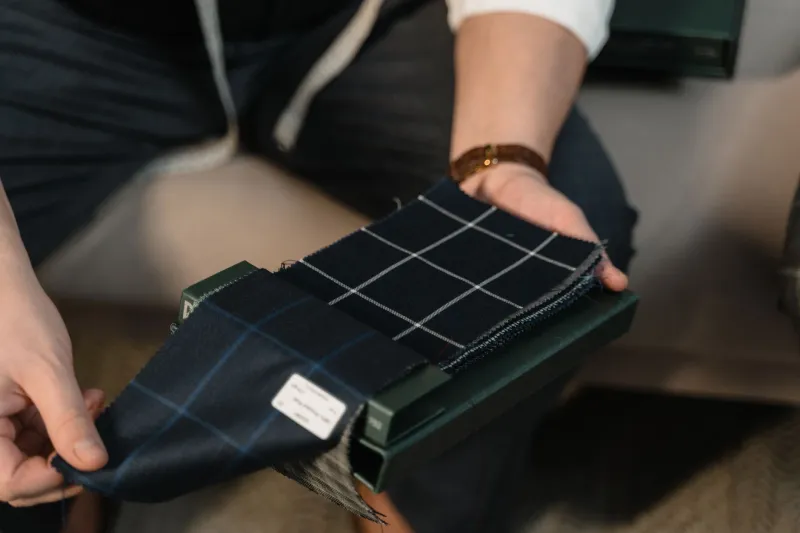
The answer is deliberate, unhurried exposure. Visit tailors — not necessarily to commission immediately, but to handle the cloth books they keep, to feel the difference between a 280-gram flannel and a 340-gram one, to understand why a tightly woven fresco feels so different from a loosely structured tweed despite both being wool. Visit shirtmakers and ask to examine the collar construction. Hold a shirt with a proper interlining against one without. The difference, once felt, cannot be unfelt.
Wear things. Wear them fully, in the conditions they were designed for. A well-constructed garment reveals its quality over time and use in a way that a hanger never permits. The chest of a canvased jacket softens and conforms to the wearer's particular posture. A quality leather shoe begins to carry the impression of its owner. These are not flaws in the material — they are evidence of integrity.
And perhaps most importantly: slow down. The tactile intelligence that separates the genuinely discerning man from the merely well-informed one cannot be acquired through reading alone. It accumulates through contact, through patience, through the willingness to handle a garment for sixty seconds rather than six.
The Quiet Reward
There is a particular satisfaction that accompanies this kind of knowledge — not the satisfaction of connoisseurship as performance, but the quieter pleasure of competence. Of knowing, when you reach for a jacket on a Tuesday morning, that you chose it for reasons that will hold. That what you felt when you first handled it was real, and that it will continue to be real in ways that a photograph never promised.
This is what the hand knows. And in menswear, as in most things that genuinely matter, it knows a great deal more than the eye.