What the Fingers Know: Developing a Tactile Fluency for Exceptional Menswear
A man walks into a store. He picks up a jacket. Within four seconds—before he has looked at the label, before he has checked the price, before a salesperson has said a word—he knows. Not thinks. Knows. The fabric tells him. The construction tells him. The weight and the drape and the way the collar responds to his touch tells him whether this garment was made with care or assembled with indifference.
This is tactile literacy, and it is among the rarest and most useful skills in menswear. It cannot be acquired from a website. It cannot be learned from photographs, however beautifully shot. It lives entirely in the hands, and it takes time and deliberate attention to develop. But once developed, it is essentially infallible.
The Limitation of the Eye
Visual assessment of clothing quality has real limits. Photography, in particular, is a sophisticated deceiver. A garment photographed under the right lighting, styled with precision, and shot at a flattering angle can appear to be something it is not. Even in person, the eye can be misled by surface finish, by pressing, by the confidence of the retail environment.
The hands are harder to fool. Fabric that has been finished with excessive sizing to simulate weight will feel stiff and papery rather than substantial. A seam that has been pressed to perfection but not properly constructed will shift under gentle tension. A button that looks correct from a distance will feel cheap—light, hollow, slightly slick—the moment it is touched.
The hands ask different questions than the eyes, and the answers they receive are more honest.
The Weight of a Button
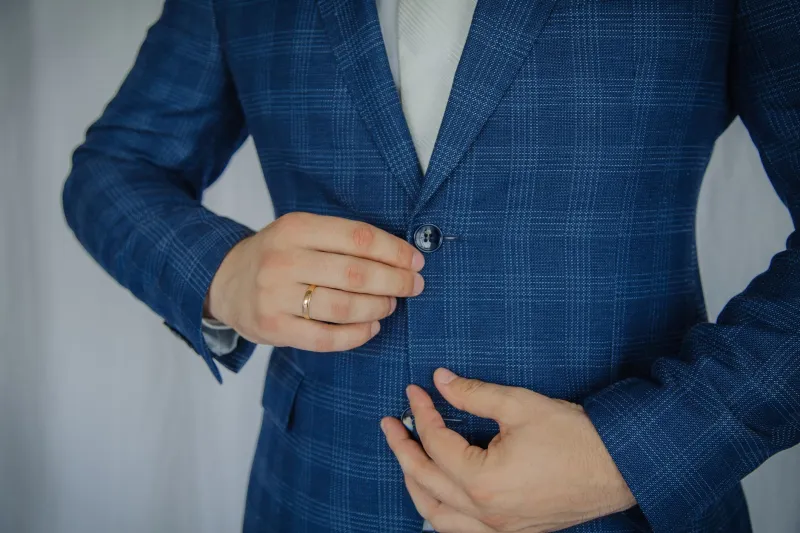
Begin, always, with the buttons. This is not an arbitrary starting point. Buttons are among the easiest components to upgrade during manufacture—a brand that uses quality buttons on an otherwise mediocre garment is rare, because there is no financial logic to it. Conversely, a garment that cuts costs on buttons is almost certainly cutting costs elsewhere.
A quality button—whether horn, mother of pearl, or dense corozo—has weight. Not heaviness, but presence. It sits in the palm with a density that synthetic buttons cannot replicate. Run a thumbnail across its surface: natural materials have a subtle texture, a slight warmth, a response that petroleum-based plastics do not possess. Horn buttons, in particular, have a depth of color and an irregularity of surface that becomes immediately apparent once you know what you are feeling for.
The buttonhole is equally instructive. On a well-made garment, the buttonhole has a clean, tight lip—the stitching is dense and even, the cut precise, the edge finished in a way that resists fraying under repeated use. On a lesser garment, the buttonhole will feel slightly loose, the stitching less regular, the opening slightly ragged at the corners. This is especially evident on the sleeve buttonholes, which on the finest garments are functional—meaning they can actually be unbuttoned—and which require a level of craftsmanship that adds measurably to the cost.
Fabric Hand: The Vocabulary of Touch
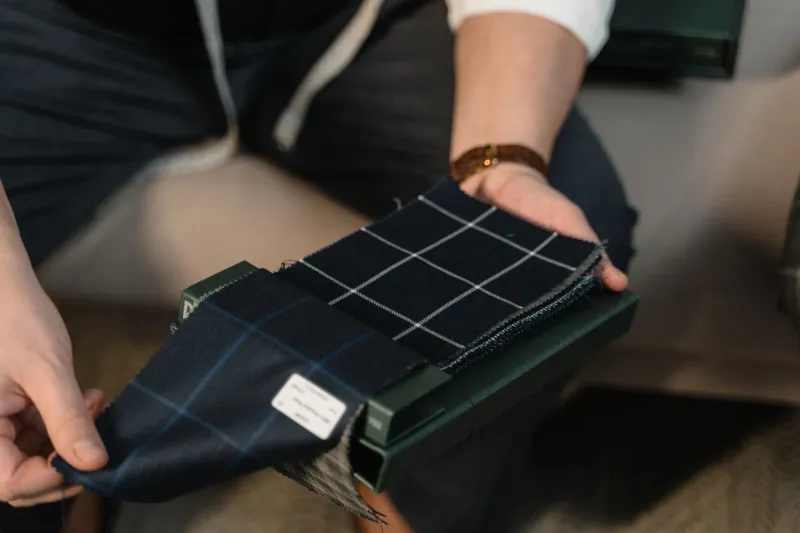
In the textile trades, the term "hand" refers to the tactile quality of a fabric—how it feels when handled. This is a rich vocabulary, and learning it is central to tactile literacy.
A fine wool suiting fabric should feel alive. It should have a slight spring to it—what the trade calls "resilience"—meaning that when you compress it gently in your fist and release, it recovers its shape with minimal wrinkling. Wool that feels limp, that holds the crease of your grip rather than releasing it, is either of poor fiber quality or has been blended with synthetics that compromise its natural properties.
Cashmere presents its own set of signals. Genuine fine cashmere—the kind sourced from the undercoat of Mongolian or Inner Mongolian goats—has a warmth and a softness that is immediately recognizable, but it also has a quality of lightness that distinguishes it from lesser fibers. Cashmere that feels heavy for its apparent thickness is often blended. Cashmere that feels excessively soft, almost slippery, has frequently been treated with softening agents that will wash out over time, leaving the garment coarser than it appeared at purchase.
For shirting, the test is different. A quality cotton shirt fabric—a two-ply poplin or a fine broadcloth—should feel smooth but not slick, with a slight crispness that is distinct from the stiffness imparted by heavy starching. Hold it up to the light: the weave should be tight and even, with no visible irregularities. Run it between thumb and forefinger and feel for a consistency of weight across the surface. Inconsistency here suggests an uneven yarn, which will translate to uneven wear.
Seams, Structure, and the Internal Architecture
The seams of a garment are its skeletal system, and they reward investigation. On a quality suit jacket, the seams should lie flat and feel substantial without being bulky. Apply gentle lateral tension to a seam and feel whether it gives cleanly or whether the stitching strains. A well-constructed seam distributes stress across the thread and the fabric; a poorly constructed one concentrates it in ways that will eventually manifest as failure.
The canvas of a jacket—the internal structure that gives the chest its shape—is perhaps the single most important quality indicator that touch can reveal. A fully canvassed jacket, in which a layer of horsehair canvas has been hand-padded to the chest, has a particular quality of three-dimensional life that fused construction cannot replicate. Pinch the chest of the jacket between thumb and forefinger: in a canvassed jacket, you will feel two distinct layers that move independently of each other. In a fused jacket, the interlining is bonded directly to the fabric, and the pinch will feel as a single, slightly stiff unit.
Neither is inherently wrong—fused construction has its appropriate applications—but knowing the difference allows a man to assess what he is purchasing with clarity.
Developing the Practice
Tactile literacy is not acquired in an afternoon. It develops through repeated, deliberate comparison—handling garments across a wide range of quality levels and paying close attention to what the hands are reporting. Visit a store that carries genuinely excellent merchandise and handle everything. Then visit a store at a lower price point and handle everything there. The contrast will be instructive in ways that no amount of reading can replicate.
Over time, the assessment becomes instantaneous. The hands develop a memory for quality, and that memory becomes the most reliable filter a man possesses. In an era when so much of commerce has moved online and so much of menswear is purchased from photographs and specifications, the man who insists on touch—who will not commit to a garment until he has held it—retains a significant advantage.
He is buying what the garment actually is, not what it appears to be. And that distinction, in the long run, is the whole of the matter.